

OITF programmes are structured interventions—governed, measurable, and designed for long-term impact. They are organised under two major categories: Capital Formation and Social Impact.
The Foundation undertakes multi-dimensional initiatives structured under two major categories: Capital Formation and Social Impact.

- Investment & Enterprise Development
• Structured Investment Vehicles (SPVs)
• Capital Pooling Platforms
• Asset-backed enterprise development
• Sector-specific deployment (Agriculture, Infrastructure, SME Support)
Purpose: Generate sustainable income streams to fund impact initiatives.
- The Savings and Recoverable Support Program (SARSP)
SARSP is OITF’s structured, member-based savings and support framework designed to promote financial discipline and responsible pooled support. It builds a culture of consistency, accountability, and transparent participation—so that members grow stronger financially while the community gains access to sustainable development capital.

Socially, SARSP mobilises pooled resources that can be deployed—under clear governance—to fund priority community projects and lasting interventions. Individually, it empowers members through disciplined savings and recoverable support that helps stabilise households, strengthen livelihoods, and encourage responsible economic progress.
Its purpose is clear: to build internal stability and a durable capital culture—starting with Ogbona first, and extending to other underserved communities as OITF’s impact expands.
Status: Currently Ongoing
- Food Security & Community Food Bank

Food Security & Community Food Bank is OITF’s structured humanitarian programme designed to protect households from hunger shocks and reduce vulnerability across underserved communities—beginning with Ogbona first. Beyond emergency response, the programme is built for long-term resilience: OITF will establish community farms and livestock systems as sustainable food sources capable of feeding households, strengthening local supply, and reducing dependence on irregular donations.
Through this programme, the Foundation will develop managed crop farms, community-backed agricultural clusters, and livestock projects—structured to provide steady staples and protein supply for the Food Bank, while also creating livelihoods, supporting local producers, and stabilising food availability over time. In doing so, OITF will move from short-term relief to self-sustaining food security infrastructure, governed with transparency and designed for measurable impact.
Purpose: To strengthen household stability, reduce vulnerability, and build a credible community food system that can endure across seasons and generations.
- Health & Medical Outreach
Health & Medical Outreach is OITF’s structured public-health programme designed to expand access to affordable, organised, and reliable medical services for underserved communities—beginning with Ogbona first. The programme combines immediate outreach interventions with long-term healthcare development, delivered through credible partnerships, verified beneficiary systems, and transparent governance.
Health Access Partnerships
OITF will build strategic partnerships with hospitals, clinics, diagnostic centres, pharmacies, HMOs, and medical professionals to create access pathways for members and vulnerable households. These partnerships will support negotiated service rates, referral systems, subsidised care windows, and coordinated medical support for priority cases—ensuring care is not left to chance or informal connections.
Community Medical Initiatives
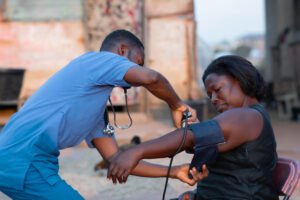
The Foundation will organise periodic medical initiatives such as community health screenings, maternal and child health support, immunisation linkages, health education, and targeted interventions for common community health burdens. Outreach will be structured—using community registers, triage protocols, and follow-up systems—so that interventions are measurable, accountable, and capable of continuity beyond one-off events.
Long-term Healthcare Infrastructure Development
Beyond outreach, OITF will pursue long-range development of healthcare capacity, including support for local health facilities, essential equipment, diagnostics, and—where feasible—structured projects that contribute to durable community healthcare infrastructure. The goal is to shift from episodic outreach to institutional healthcare improvement that can serve the community consistently over time.
Purpose: To expand access to affordable and structured medical services, reduce preventable health crises, and strengthen community wellbeing through a credible, partnership-driven health framework.
- Education & Scholarship Support
Education & Scholarship Support is OITF’s human-capital programme designed to expand access to learning opportunities and build a pipeline of capable, empowered young people—beginning with Ogbona first. The programme supports education from foundational levels through higher education and professional development, while also promoting employable skills, vocational excellence, and lifelong capacity-building.

Student Scholarships
OITF will provide structured scholarships to deserving students based on clear criteria—such as merit, demonstrated need, and community impact potential. Support may cover school fees, examination costs, learning materials, and other critical education barriers, with transparent selection and monitoring processes.
Educational Grants
In addition to individual scholarships, the Foundation will offer educational grants targeted at practical needs: learning resources, school support interventions, community learning projects, and initiatives that improve educational access and outcomes. Grants will be guided by measurable deliverables and accountability standards.
Capacity-building Initiatives
OITF will organise capacity-building programmes that strengthen academic performance, leadership, civic responsibility, and personal development. This includes mentorship, career guidance, digital literacy support, and structured academic enrichment—helping beneficiaries grow into responsible and impactful contributors.
Skills and Technical Training
Recognising that education must also translate into livelihood, OITF will support skills acquisition and technical training—vocational pathways, apprenticeships, and job-ready learning—especially for youths and women. The aim is to enable practical competence, entrepreneurship, and employability.
Purpose: To invest in human capital by removing barriers to education, strengthening capacity, and building skilled, confident individuals who can drive sustainable progress for their families and communities.
- Community Infrastructure Development
Community Infrastructure Development is OITF’s long-term institutional programme designed to build the physical and operational structures that communities need to function, grow, and thrive—beginning with Ogbona first. The programme is anchored on a simple principle: development must be durable and organised, not reactive or temporary. OITF therefore prioritises infrastructure that strengthens coordination, improves productivity, and enables sustainable service delivery.
Office and Coordination Hubs
OITF will establish modest but functional community coordination hubs—spaces that serve as programme offices, planning centres, volunteer coordination points, and service delivery anchors. These hubs will support record-keeping, beneficiary verification, stakeholder engagement, and structured programme implementation. They also provide a stable interface for partners, donors, and development agencies seeking credible local collaboration.
Agricultural Infrastructure

To support food security and local productivity, the Foundation will develop and enable agricultural infrastructure that strengthens value chains and reduces post-harvest losses. This may include storage solutions, aggregation points, basic processing support, farm access facilitation, and operational structures that improve agricultural efficiency and community resilience. The goal is to shift from subsistence limitations to organized community production capacity.
Development Partnerships
OITF will pursue development partnerships with government agencies, corporate organizations, diaspora institutions, NGOs, and international partners to co-design and co-fund infrastructure interventions. These partnerships will be guided by clear governance, accountability mechanisms, and measurable outcomes—ensuring projects are not only built but maintained and responsibly managed.
Purpose: To build enduring structures, not temporary relief — creating the institutional backbone and development assets that communities can rely on for years, not days.